Why your website doesn’t convert and what premium brands do differently

Key takeaways
- Traffic alone does not generate inquiries
- Positioning comes before design
- Trust is built before the contact form
- A clear next action increases conversion
Why traffic alone is not enough
When inquiries don't come in, the cause is rarely a lack of traffic. Often what is missing is clarity, structure and strategic intent on the website itself.
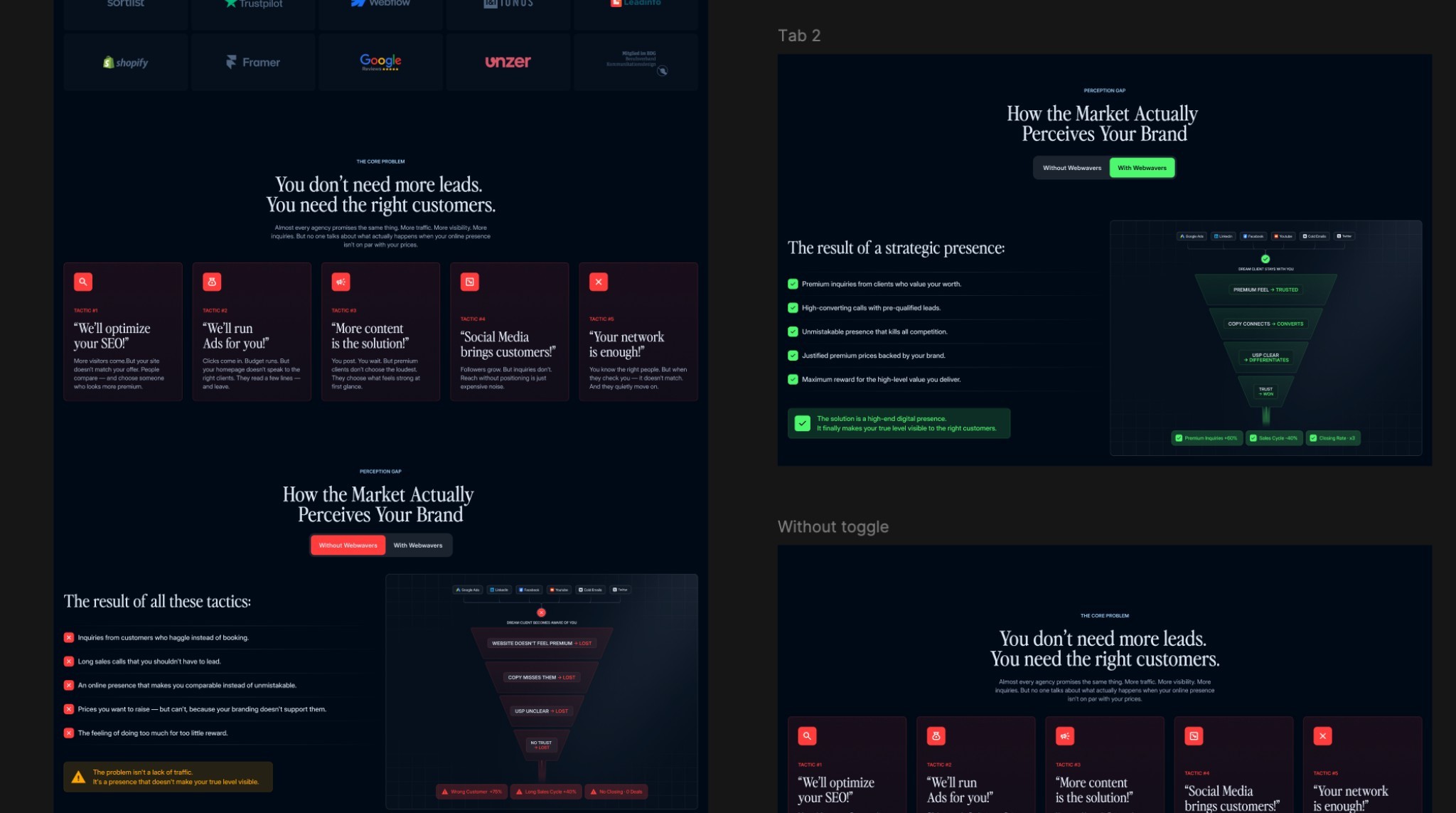
Understanding how to improve your website's conversion rate starts with a change of perspective. Your website is not a brochure. It is a sales tool. Every section, every headline, every button either brings a visitor closer to taking action or drives them away. Premium brands understand this exactly, and that is precisely why their websites consistently outperform the competition.
Your website is not a brochure. It is your most powerful sales tool. Every section, every headline, every button decides whether a visitor becomes a customer or not.
The real reasons most websites don't convert
Before we get into specific measures, it is worth knowing the most common causes of weak website performance. These problems are not always obvious, but they create enough friction to lose potential customers.
Weak value proposition above the fold
The first thing a visitor sees on your website has to answer one question: What's in it for me? If your headline is vague, generic or focused on your company instead of the visitor's problem, you lose them within seconds. Premium brands rely on clarity and communicate results. They immediately show visitors what they can expect and why it matters.
Poor visual hierarchy and layout
If everything on your page seems equally important, nothing stands out. Many websites suffer from cluttered layouts where calls to action compete with decorative elements, navigation menus and secondary content. Website conversion best practices include designing a visual hierarchy that naturally guides the visitor's eye from the headline to the value proposition to the call to action.
Missing trust signals
Visitors don't convert if they don't trust you. Missing testimonials, no case studies, no recognizable client logos and no social proof create hesitation. This is especially important in B2B website conversion optimization best practices, where the buying cycle is longer and decisions carry more weight. Trust has to be built into every section of the page.
Slow loading speed
Studies consistently show that even a one-second delay in load time can significantly reduce conversions. In 2026, with attention spans shorter than ever, speed is not a technical detail but a conversion factor. Google also uses page speed as a ranking signal, which means slow pages lose both visibility and visitor engagement at the same time.
Unclear or hidden calls to action
If visitors have to search for your contact form or your CTA button fades into the background, you lose conversions. The best websites make their primary call to action obvious, repeat it across the page and phrase it in an action-oriented way. Replace generic labels like "Submit" with specific phrases like "Book your free strategy call".
How premium brands approach website conversions
If you want to understand how to increase website conversions, the fastest way is to study what high-performing brands do differently. Premium agencies and service businesses treat their websites as conversion systems, not as digital brochures.
They design for one clear action per page
Every page of a premium website has a single primary goal. A landing page should generate leads. A service page should book a call. A case study should build trust. If you try to achieve too many things on one page, you won't achieve any of them really well. This principle is central to understanding how to increase conversion rates on websites.
They use data for design decisions
Premium brands don't guess what works. They use analytics, heatmaps and session recordings to analyze website visitor behavior for conversion rate optimization. They identify where visitors drop off, which sections get the most attention and which CTAs perform best. This data-driven approach is what separates consistent top performers from everyone else.
They invest in A/B testing
One of the most effective methods of conversion optimization is A/B testing. Understanding how to use A/B testing to improve your website conversion rate means systematically testing different headlines, layouts, button colors, form lengths and page structures against each other. Even small changes, like the position of a testimonial or a shorter form, can bring noticeable improvements in conversion rate.
Smart companies also know how to keep increasing website conversions through A/B testing by building an ongoing testing cycle instead of running one-off experiments. The goal is continuous optimization, not a one-time fix.
They prioritize the mobile experience
With more than 60 percent of web traffic now coming from mobile devices, a website that doesn't work well on smartphones is leaving money on the table. Premium brands design mobile-first and make sure navigation, CTAs and forms are optimized for touch interaction and smaller screens.
Practical steps to improve your conversion rate
If you are serious about increasing the conversion rate on your website, here is a practical framework you can follow. These steps work equally well for service businesses, e-commerce stores, consulting firms and B2B companies.
Step 1: Analyze your current performance
Start by understanding your baseline. Install proper analytics tracking, set up conversion goals and use heatmapping tools to see how visitors interact with your pages. Look at your most visited pages first, because that is where improvements will have the biggest impact.
Step 2: Sharpen your message
Review every important page and ask yourself whether the headline clearly communicates the benefit to the visitor. Remove jargon, shorten sentences and lead with results. For consulting firms that want to improve their website conversion rate, this step is crucial. Your message should speak directly to your ideal client's pain points and position your company as the clear solution.
Step 3: Redesign for conversion
If your website was built primarily for aesthetics without considering conversion principles, a strategic redesign can deliver transformative results. With professional website design services for conversions, you make sure every element (from layout and typography to button placement and form design) is geared toward turning visitors into leads.
Step 4: Optimize your forms
Forms are where conversions happen or fail. Reduce the number of fields to what is absolutely necessary for the first contact. Use progressive profiling to collect more information later. Test multi-step forms against single-step forms to find out what works best for your audience.
Step 5: Build a testing culture
Conversion optimization is not a one-off project. The best websites are continuously tested and refined. Establish a regular A/B testing rhythm, review your analytics monthly and treat every change as a hypothesis you want to validate.

Industry-specific considerations
For e-commerce businesses
If you want to know how to design an effective e-commerce website for conversions, focus on optimizing product pages, streamlining checkout processes and using urgency and social proof strategically. High-resolution images, clear pricing and visible reviews are essential. The checkout process should be as short as possible, with a guest checkout option and multiple payment methods.
For B2B and consulting firms
B2B websites often fail because they try to sell right away instead of building trust first. B2B website conversion optimization best practices include relying on educational content, detailed case studies and clear paths from awareness to inquiry. Your website should demonstrate expertise before it asks for the deal.
Conclusion: Your website should be your best salesperson
Understanding how to improve the conversion rate on your website ultimately means respecting your visitor's time and making their decision as easy as possible. Every element on your page should serve a purpose. Every section should move the visitor forward. Every page should have a clear next step.
The difference between a website that converts and one that doesn't is rarely dramatic. It is the sum of many small, deliberate decisions: a clear message, strategic layout, genuine trust signals, fast performance and continuous testing. Premium brands get this right because they treat their websites as living, evolving conversion tools and not as static digital billboards.
If your website isn't delivering the results you want, the way forward starts with understanding your visitors, eliminating friction and designing every page with conversion as the top priority.


More articles